Sub-Zero condenser and coil service
Condenser cleaning and corrosion inspection, planned around marine aerosol rather than a generic annual interval.
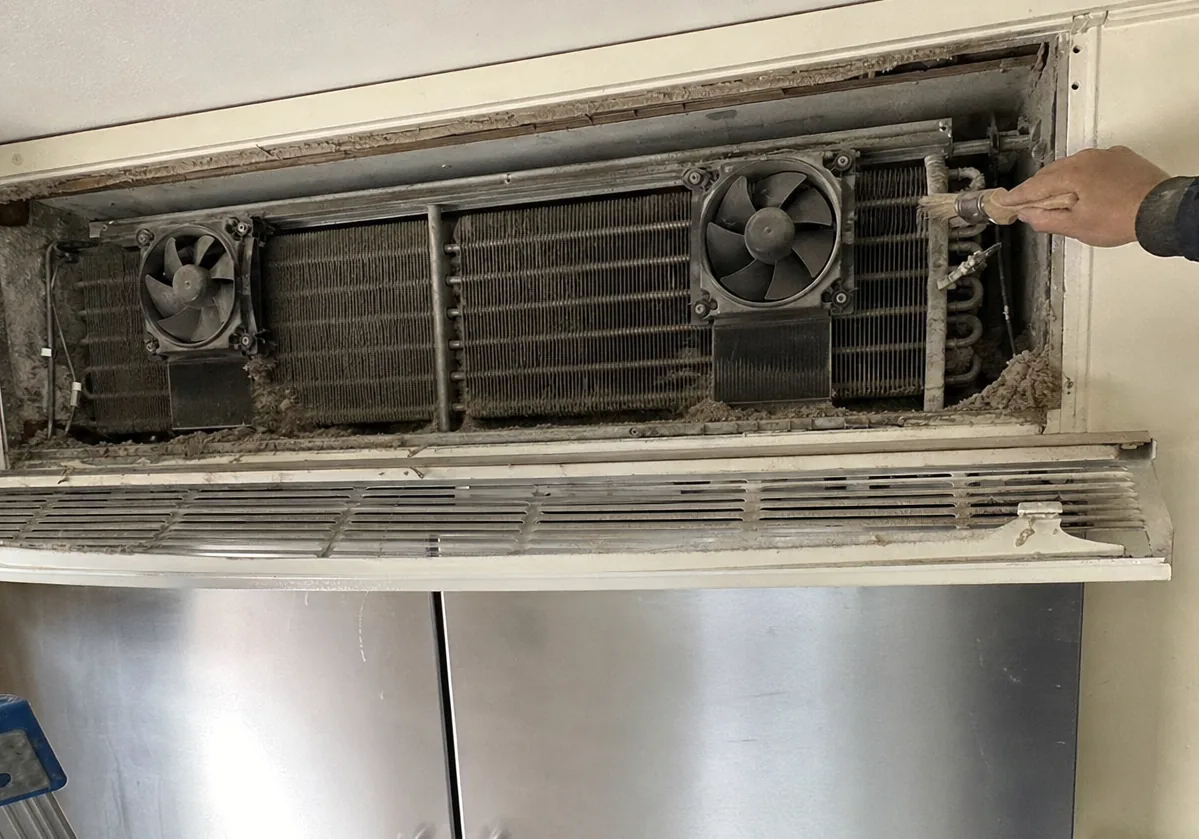
What people call about
- Cabinet runs warmer than the set point
- Compressor runs longer than it used to
- Machine compartment is hot to the hand
- Grille dust mats within weeks of cleaning
- Green or white powder on fin edges
Symptoms, not fault codes. We read the machine in front of us rather than guessing from a list.
The condenser is where a Sub-Zero gives its heat back to the room. Refrigerant leaves the compressor hot and under pressure, runs through a finned coil, and has to cool enough to become a liquid again before it reaches the evaporator. If the coil cannot shed that heat, nothing downstream behaves. The cabinet drifts warm, the compressor runs longer to make up the difference, and every component in the machine compartment lives at a higher temperature than it was built for.
On this island the coil rarely fails outright. It gets buried.
What lands on a condenser three blocks from the dune line
The air here carries chloride. Breaking surf throws off a fine aerosol, the onshore breeze carries it inland, and it settles on everything — windshields, hinge pins, the edges of a stainless panel that has gone dull while the middle still looks new. The condenser fan pulls that same air through the fins by design, because moving room air across the coil is the entire job.
Salt alone would only be untidy. The problem is that salt is hygroscopic: it pulls moisture out of humid air and holds a damp film on the aluminium. Lint, pet hair and beach sand then bond to that film instead of blowing off it. Inland, a neglected condenser collects a dry mat you can lift away in one piece. Here it collects something closer to felt, and a vacuum nozzle skates over the top of it.
Under the mat, two dissimilar metals sit in contact with a salt-water electrolyte between them: aluminium fin, copper tube. The result shows up as a white or pale green bloom along the fin edges and as fin material that has gone thin and chalky where incoming air strikes it first. Once the leading edge has eroded, the coil has permanently lost surface area. Cleaning does not give that back, which is the whole argument for cleaning before it happens rather than after.
Reading a coil before the thermometer says anything
A condenser tells you its history well before a temperature complaint does. We look at three things in order.
The leading edge of the fin pack shows corrosion first, because that is where the air load is heaviest. Bright metal is fine. A dull grey film is normal. White powder that comes away on a fingertip is aluminium already giving up.
Fastener heads and the fan shroud show what the humidity is doing to everything that is not aluminium. Rust bleeding from a screw head in a machine compartment means the compartment has been running damp, which usually means the airflow through it has been restricted for a while.
The fan blade and motor tell you whether the coil has been fighting alone. A blade coated on the leading face is moving far less air than its rating, and a motor that has been working against a blocked coil is often the next part to go.
Interval, not procedure
Every manual in the category suggests cleaning the condenser periodically. That advice is written for a national audience and it is too slow for the beaches.
Within a few blocks of the ocean we plan on cleaning three or four times a year. Further west, on the Intracoastal side of the island, twice a year is usually enough. Homes with a dog, a shedding cat or an open-plan kitchen that pulls cooking aerosol toward the grille move to the shorter interval regardless of where they sit. The point is that the schedule should be set by the address and the household, not by a page in a booklet.
What the work actually is
We pull the grille, photograph the coil before touching it, and clean along the fin direction with a soft brush and a HEPA vacuum. No pressure washer, no garden hose, no wire brush, no compressed air blasting debris deeper into the pack. Bent fins get straightened with a comb where the spacing allows it. The fan blade is cleaned and checked for balance, the shroud is reseated, the drain path is cleared, and the compartment is wiped down so that the next season’s salt is landing on clean metal rather than on last season’s deposit.
Then we take readings. Condenser inlet and outlet temperatures, compartment ambient, and run time after the door has been closed for a while. Those numbers are what tell us whether the coil was the whole story or whether something in the sealed system needs a closer look. If the cabinet still will not hold after a clean coil and a healthy fan, the problem is elsewhere and we say so in writing rather than selling another cleaning.
When to call rather than wait
Call if the grille area is hot enough to be uncomfortable to hold a hand against, if the compressor is running far longer between rests than it did last year, if you can see white bloom on the fin edges, or if the coil mats up again within a few weeks of being cleaned. That last one is not a cleaning problem. It is usually an airflow problem, and it is worth finding before the compressor pays for it.
How the visit runs
- Diagnostic, $80 flat. Flat $80 diagnostic. It is credited toward the repair if you go ahead with the work.
- Written finding. What is wrong, what caused it, and what the cabinet will do if it is left alone.
- Written estimate. You get a written estimate before any part is ordered or any labor is billed.
- Repair. Genuine OEM parts, and the condenser cleaned before we leave whether or not it was the fault.
Updated August 15, 2026. See pricing and warranty for the full terms.
What does condenser and coil service cost?
Flat $80 diagnostic covering the visit and the full diagnostic sequence, credited toward the repair once you approve the work.
| Work | Typical range |
|---|---|
| Diagnostic visit | $80 flat, credited |
| Compressor or sealed-system repair | $920–$2,380 |
| Evaporator or condenser fan motor | $270–$590 |
Ranges, not quotes. What a cabinet actually needs is settled by readings taken with the grille off, and the figure you are asked to approve is written down before a part is ordered. The whole table is on the pricing page.
How often should a condenser be cleaned this close to the dune line?
- Three to four times a year in the first few streets off the ocean, twice a year further back. The once-a-year interval written for an inland kitchen does not survive here, because the fin pack is loading with chloride every day the wind comes onshore rather than with household dust alone.
Can I clean the coil myself with a vacuum?
- You can try, and on this coast it mostly rides over the problem. Salt is hygroscopic: it holds damp in the fin pack and binds lint into a felt that a nozzle skates across. A soft brush worked with the fins, and a fin comb where they are bent, is what actually lifts it.
If the fins are already corroded, is cleaning still worth it?
- Sometimes, and we will say which case you have rather than decide it for you. Cleaning a loaded coil buys back run time and head pressure immediately. Where aluminium has been eaten back to nothing in places, cleaning buys time and no more, and you should hear that before you pay for it.